

Egypt was my partner’s dream trip more than mine. I always thought it would be interesting, but I wasn’t prepared for how much it would get to me. Nowhere has given me a sense of how our civilization evolved like Egypt has. Seeing that much history up close made me feel more connected to humanity, and I really wasn’t expecting that. It’s now one of my favorite places I’ve ever been, and I’d recommend it to anyone who can go.
But there was one thing at the back of my mind leading up to the trip. I’ve been vegan for over 15 years, and I knew Egypt wasn’t going to be the easiest country I’d ever eaten my way around. Veganism isn’t really part of the culture there, and I wouldn’t expect it to be, so there’d be none of the vegan labels we’re spoiled with back home in Europe. This wasn’t a trip I could wing with a hopeful smile and a bag of nuts. My advice to anyone heading somewhere veganism isn’t the norm is always the same: plan ahead. That’s what this post is for.
I knew from past trips that choosing a tour over going it alone can help with exactly this, so that’s what I did. Twice, in fact. When I went in January 2026, I wanted to see as much as I possibly could, so I started with a private tour around Cairo, Alexandria and the Fayoum desert, then joined a seven-day group tour that took us south to Aswan and Luxor. Here’s what it was actually like.
Is Egypt hard for vegans?
Yes and no. You won’t find vegan menus, and you’ll do a fair amount of gentle detective work at buffets. But a lot of Egyptian food is plant-based to begin with, and most visitors never notice. Some of the country’s oldest and most traditional dishes are naturally vegan, partly because many Coptic Christians fast from animal products for long stretches of the year, so they’re common and easy to find. Where it gets harder is variety. If you’re hoping for lots of different cuisines, or the Western-style vegan options you’d find at home, you’ll need to be flexible.
You won’t starve. You’ll just eat a lot of the same delicious things, and you’ll need to be a little more prepared than you would in some other countries. The good news is that on an organized tour, a lot of that work is already done for you before you land.
How does a tour cater for vegans?
Some of my most memorable vegan meals have been on tours. On the Inca Trail, our trek cook fed me so well that the rest of the group wanted my food, and in the American South a guide got me a vegan meal at a barbecue joint I’d never have walked into on my own.
In Egypt, it works a little differently. Tour operators use hotels, restaurants and cruise boats that are used to feeding all kinds of travelers, so there are options for everyone. They’re not always the places I’d pick on my own, but that’s the point: they’re set up so nobody goes hungry. And if we had a question about a dish, our guides would ask the staff for us.
Your part is communication. Before you book, look at which meals are included and what the operator says about dietary needs. I chose my group tour partly because a vegan colleague had traveled with the same company, and their FAQs mentioned catering for vegans. Then get in touch, tell them you’re vegan, spell out what that means (no meat, fish, dairy, eggs or honey), and make sure they’re comfortable catering for you. When I contacted mine, they came straight back: they’d catered for plenty of vegans, knew exactly what was needed, and it wouldn’t be an issue at any point on the tour. That gave me every confidence I’d be well looked after.
Starting in Cairo
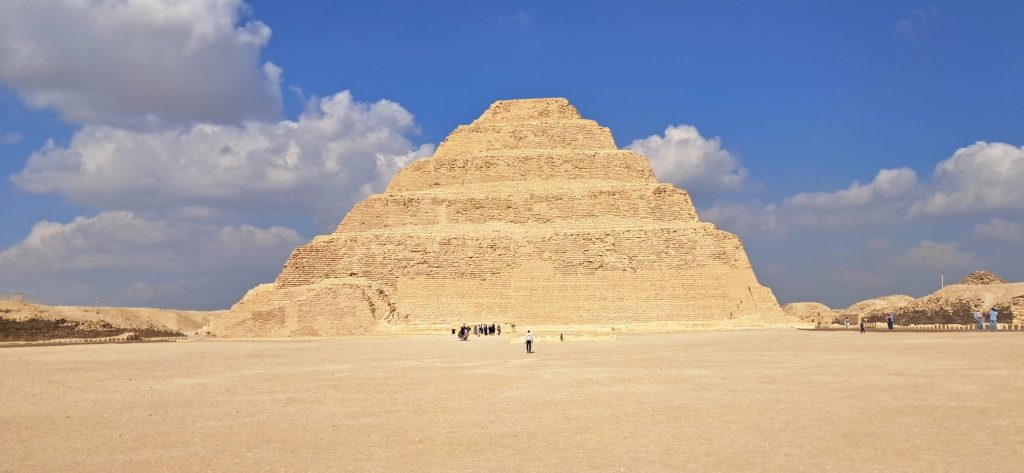
Our private tour was based near the pyramids in Giza. With just the two of us, we could shape the days around what we wanted to see, including a trip out into the desert to Wadi Al-Hitan, where 40-million-year-old whale skeletons lie in the sand.
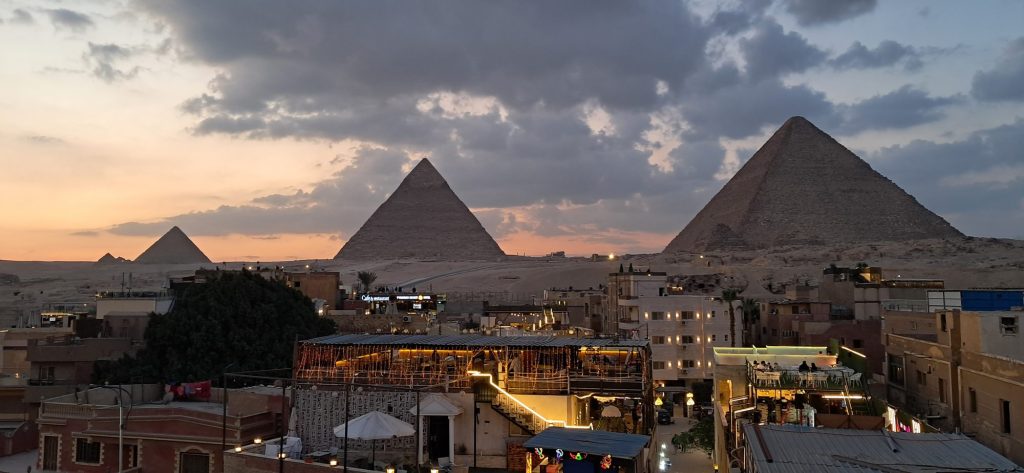
The food got off to a brilliant start. Every morning at our first hotel, we ate ful, ta’ameya and fresh bread on a rooftop overlooking the pyramids. You can’t beat it. For dinner, the owners pointed us to their own rooftop restaurant. They already knew what we could and couldn’t eat, so they told us exactly what to order, including koshari and stuffed vine leaves (my favorite). We went back three nights running.
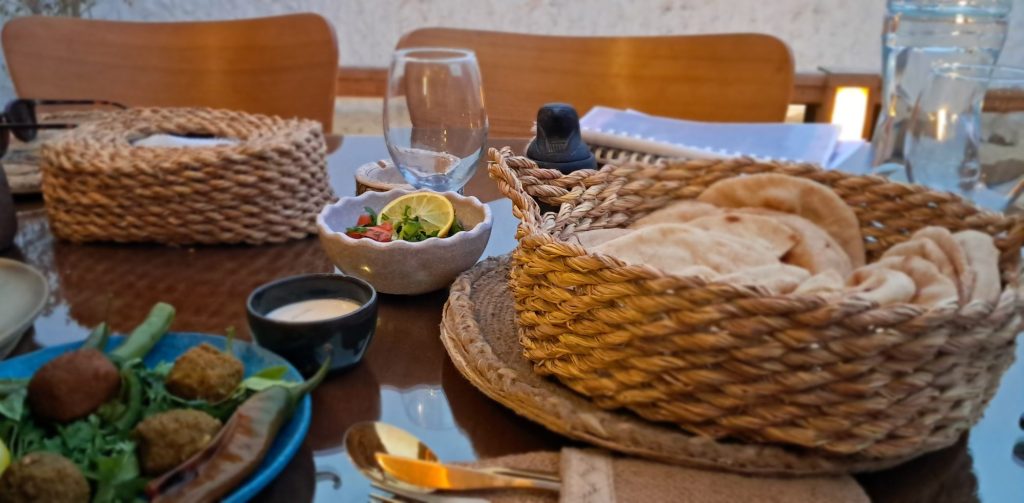
When we joined the group tour, our hotel in Giza had a big breakfast buffet with plenty for us to choose from. Ful, ta’ameya and bread are the traditional Egyptian breakfast, and you’ll find them at hotels all over the country. They were what I ate most on the whole trip, and I never got tired of them.
Can you get vegan food on the sleeper train?
Everything I read online said no. If you book the Cairo to Aswan sleeper train yourself, the closest you can get is a vegetarian meal, and you can’t opt out of the meal either. (I’d happily have skipped it and brought my own food, rather than have a meal go to waste.)
My tour operator said they could arrange it. I didn’t believe them, so I asked again closer to the date, and they still said yes. Our guide, Mina, waited with us at the station (our train was only 45 minutes late, which is pretty good going by some of the stories I’ve heard) and made sure our expectations of the train were low, food included. So I knew what I was in for.
Dinner arrived about an hour out of Cairo, brought by an incredibly friendly host: rice, roasted potatoes, fries and a little pot of pickled vegetables, which I especially loved. Carbs on carbs. But it was vegan, and after everything I’d read, I’ll take it.
I can’t say the same for breakfast. That’s where things got a little muddled: croissants, yogurt and other bits that clearly had dairy in them. I left them in the carriage and hoped someone would eat them. As always, I had snacks, so it wasn’t a problem.
The sleeper train divides opinion, and these days most travelers fly between Cairo and Aswan instead. But I’ve taken sleeper trains before, in countries like India, so I knew what I was getting into, and I loved it. The cabin was more comfortable than I expected, I slept well, and there’s something about falling asleep to the rattle of the carriage in Cairo and waking up with the Nile valley sliding past the window. If you’re up for some rustic charm and don’t mind roughing it a little, I’d highly recommend it.
What’s the food like on a Nile cruise?
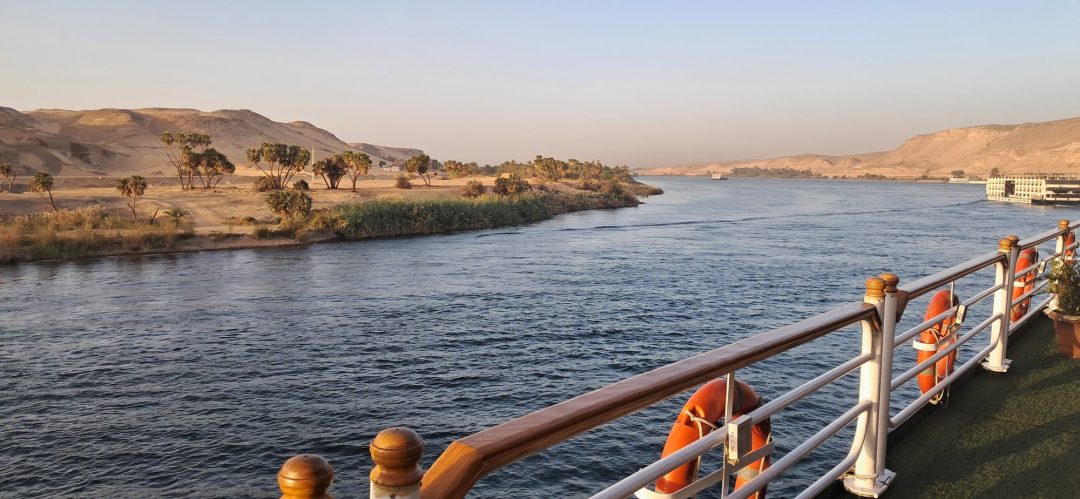
After a few busy days in Cairo and a night on the train, the cruise was the perfect chance to slow down. I wasn’t sure what to expect, and even though we went in peak season, the boat felt spacious, with plenty of room on the top deck. I spent the afternoons up there with a book while palm trees and dusty desert hills drifted by. In the evening, the sky turned pink, then purple, as the sun went down. One night we pulled in at Kom Ombo after dark and walked through the temple lit up against a black sky. I still think about it.
The food was simpler. Like almost every Nile cruise, ours had meals included, mostly as a buffet, and nothing was labeled. What I could eat: hummus, tahini, rice, grilled vegetables, chickpeas, beans and salads (mostly undressed, which made life easier), plus plenty of flatbread and, some days, pasta with tomato sauce. My options were much the same at most meals, but they kept me going, there was always plenty, and eating with the Nile drifting past never got old.
The cruise chefs weren’t always sure what to give us, so Mina did the talking. He knew exactly what we could and couldn’t eat, and checked in with us at every meal.
That came in handy on our one à la carte night, when the kitchen made me something special: a mozzarella and tomato dish that was mostly mozzarella. (Somewhere along the way, vegan had become vegetarian.) The waiter put it down in front of us without a word, but Mina spotted it and spoke to the kitchen. They came back, took it away and brought grilled vegetables and rice instead.
What about the early starts and packed breakfasts?
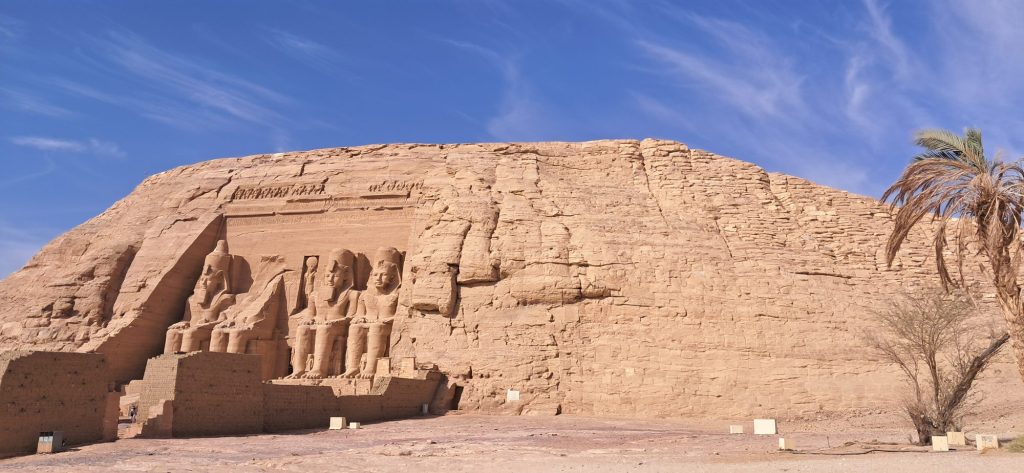
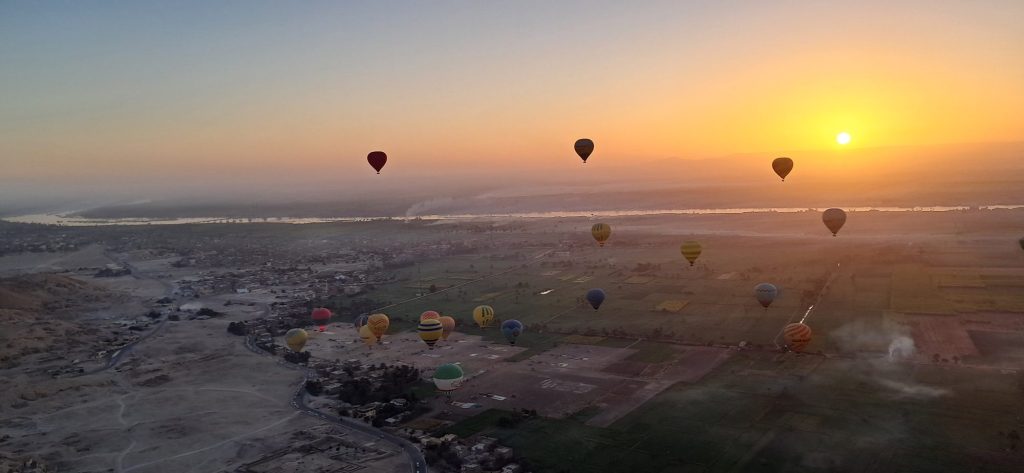
Some of Egypt’s biggest moments start before dawn. The road trip to Abu Simbel leaves Aswan around 5am and takes about four hours each way across the desert. It’s a long day, and completely worth it when you’re finally standing beneath the four giant seated statues of Ramses II. The same goes for a sunrise hot air balloon ride over Luxor. On mornings like these, breakfast is the last thing on your mind, but it helps to have something in your bag.
Breakfast on early cruise mornings comes as a takeaway bag. Before our first early start, the kitchen rang Mina, worried because they weren’t sure what to give us, and he asked me what I’d like. I figured there aren’t many vegan-friendly takeaway options in Egypt, so I suggested fruit, and the next morning I was handed a bag absolutely full of it. Not a little bag. A big one. There was so much that we couldn’t finish it in the next three days, so we had a stockpile in our cabin. I also had my protein bars, which at this point in my vegan life go everywhere I do, so it worked out fine.
There’s a café at Abu Simbel for lunch, and the big shop next to it was a surprise hit: a whole range of snacks labeled vegan, from hummus chips to wafers and all sorts of sweet treats. Nine days in. Chocolate biscuits. I was thrilled.
What are the lunch stops like?
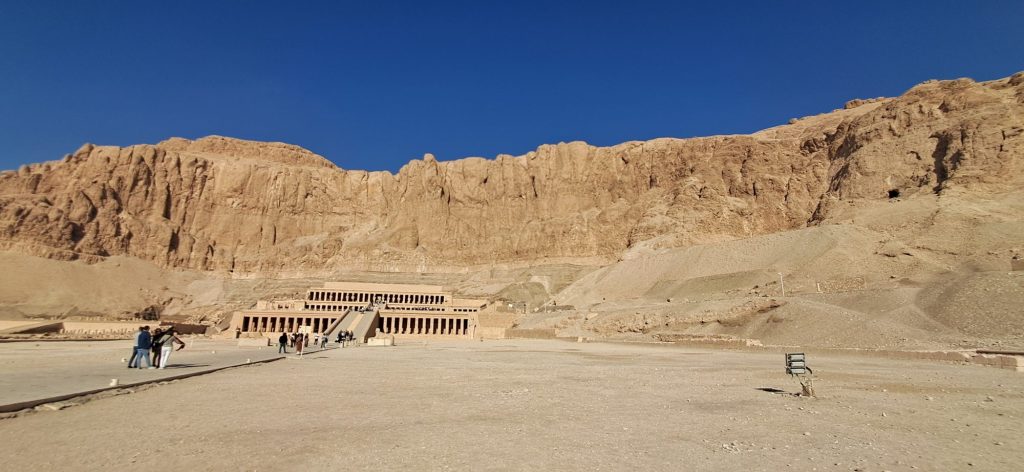
On big sightseeing days, especially when you’re traveling between places, most tours stop at a tourist buffet restaurant along the way. On our group tour, we stopped at one in Cairo and again in Luxor, on the day we saw Hatshepsut’s temple and the Valley of the Kings. That was my favorite day of the whole trip, with Mina, a qualified Egyptologist, as our personal historian.
These lunches weren’t included in our tour, so they were optional, and our guide always checked in with us first: had we had a look, were we happy with what was on offer, and did we want to eat there? The vegan options were simple, much like the cruise, but there was enough. Some dishes were obviously fine, but nothing said exactly what was in it, so I stuck to the plainer dishes. And you won’t lose an hour of sightseeing hunting for somewhere to eat.
On our private tour, with just the two of us, we had more say. The usual stops, a buffet near Coptic Cairo and a fish restaurant on our Alexandria day, didn’t have much for us, and we’d rather spend the time sightseeing, so we skipped them. Whether you stop is completely up to you. Most days wrapped up around 3pm, and after a big breakfast we were happy to wait. Our guide was lovely about it too, coming into shops with us and helping us pick out snacks at good prices.
What should you eat when meals aren’t included?
Not every meal is included on a tour, and you’ll have the odd free evening or lunch to sort out yourself. These are the dishes worth knowing.
Koshari. The national dish: rice, lentils, chickpeas and macaroni under a spiced tomato sauce and crispy fried onions. Cheap, filling and sold everywhere, it’s ideal for a free evening.
Ful. Fava beans slow-cooked with olive oil, lemon, garlic and cumin. It’s hearty, full of protein and one of Egypt’s oldest dishes.
Ta’ameya (Egyptian falafel). Made with fava beans instead of chickpeas, so it’s greener inside and denser than the version you know.
Everything else. Warm flatbread with almost every meal, hummus on almost every buffet, and plain salads of cucumber, tomato and beetroot, often with no dressing at all. Stuffed vine leaves are usually rice and herbs, but some have minced meat, so ask.
A few things to double-check when you’re ordering for yourself: butter or ghee in rice dishes, what’s in any salad dressing, and any bread that isn’t Egyptian flatbread. The flatbread itself is usually just flour, water and yeast, but hotel rolls and pastries often have milk, butter or egg in them. Tahini and hummus are a safe bet, and they livened up a lot of rice, chickpea and salad meals. Luckily, I love that kind of food.
If you’re craving something sweet, I didn’t come across any desserts I could eat, but the little corner kiosks (a kushk in Egypt) are worth a look. Date-filled biscuits are everywhere, tasty and often vegan, and I found a few other filled biscuits whose ingredients looked vegan, plus the occasional snack actually labeled vegan. Many packaged foods list their ingredients in English as well as Arabic, so you can check for yourself.
And good news for coffee lovers: forget your oat milk latte and order an Egyptian coffee. It’s very finely ground, often spiced with cardamom, boiled in a small pot and poured into the cup grounds and all (let it settle, and skip the last sip). Strong, black, naturally vegan, and I loved it.
My top vegan tips for touring Egypt
Talk to your operator, then your guide. Before you travel, ask your operator whether they can cater for vegans, and spell out exactly what that means. When you arrive, have a quick word with your guide too, including that you might not want to eat at every usual stop. Mine already knew everything, but it doesn’t hurt to check.
Eat a big breakfast. Ful, ta’ameya and bread are everywhere in the morning, and they’ll keep you going for hours. If a lunch stop doesn’t have much for you, or you skip it like we did, breakfast will carry you through the day.
Snacks, snacks, snacks. Over the years I’ve learned to always have something on me, because when there’s nothing suitable it can quickly turn into a nightmare. Bring a few favorites from home, and stock up on dates, nuts and dried fruit once you’re there.
Finish in Dahab if you can. If you have time after your tour, head to Dahab on the Red Sea. It’s the one place in Egypt where I found dedicated vegan restaurants, and after a week of buffets, it felt like a treat.
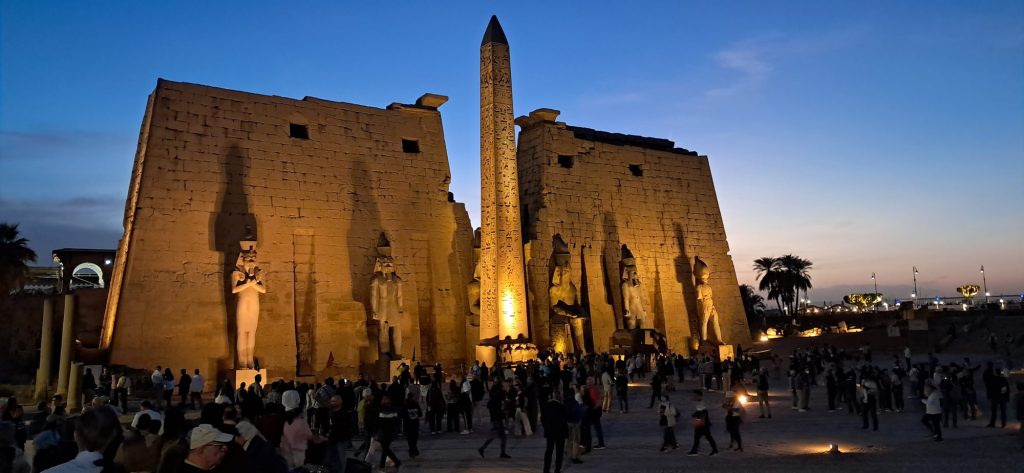
Egypt won’t hand you a vegan menu. But it gave me breakfast with a view of the pyramids, a guide who made sure we were fed the whole way, and more fruit than two people could get through in three days. Plan for the food, and the rest takes care of itself.
Ready to go? Browse tours in Egypt.